Dr Linda Aulin team leader Pharmacometrics
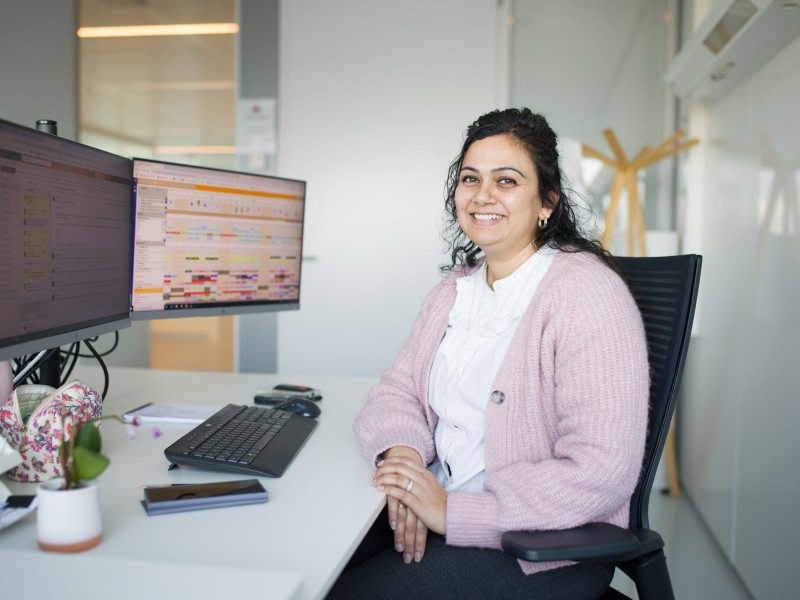
Shortly after joining the pharmacometrics team, Swedish pharmacist Dr Linda Aulin was asked to lead it. She wants to contribute to CHDR’s scientific approach to drug development.
‘I love the combination of scientific and operational tasks here at CHDR’, says Dr Linda Aulin. She joined the organisation as a member of the pharmacometrics team in January 2024, and in May she became its leader. Trained as a pharmacist in her native country Sweden, she went on to obtain her PhD at the Leiden Academic Center for Drug Research. Her thesis ‘Quantitative Pharmacology of Antimicrobials’ contains a section in which biomarkers measured during CHDR’s LPS-model is quantitatively characterized to better understand a part of the host response related to bacterial infections. One of CHDR’s Research Directors, Matthijs Moerland co-authored two of the articles that became chapters in my thesis. When I went to Berlin to do postdoctoral research, we kept in touch, and that’s how I heard about the job opening at pharmacometrics,’ says Aulin.
In Berlin, Aulin contributed to the work of the Clinical Pharmacy group at the Freie Universität (Free University), working on models that bridge preclinical and early clinical drug development. ‘It was an excellent preparation for my current job’, she says, ‘I’ve had quite a broad exposure to different kinds of pharmacokinetic modelling, including population pharmacokinetic modelling, physiologically based modelling and semi-mechanistic modelling.
Customised analysis
CHDR’s pharmacometrics team consists of four people, two pharmacometricians and two, pharmacokinetics data analysts. They are in charge of both the pharmacokinetic reporting of each study and the scientific pharmacometrics analysis. Aulin: ‘That’s what I mean with operational and scientific tasks. The operational side is to provide the usual non-compartmental analysis, which is a basic but very robust analysis often used in drug development. My colleagues who are PK data analysts mainly focus on those operational tasks, but I’m also involved. We can always customise our analysis to meet the requirements of the client. And then there are questions that require a scientific analysis. For example, when a client wants us to use the data we have generated here to develop a model and to run simulations to find the optimal way to dose in a large phase three trial. But we are also involved in discussions with the client before the protocol is even written, and during the writing of the protocol. That’s what makes it interesting for me, but we can use this scientific toolbox to answer our clients’ questions.’
Interested in learning more?
More articles from Developing people